Charitable Gift Planning in Early America
When did American gift planning begin?
Written records are basic materials for historians. Unfortunately, no records of charitable giving by Native American populations before European settlement have survived, and there is little information about the colonists who attempted to settle in Roanoke, North Carolina in the 1580s.
Surviving documents show that some of America’s earliest European immigrants provided charitable bequests through their wills, continuing a long tradition. Notable bequests in Jamestown, Virginia date from the 1620s. Four Mayflower Pilgrims, including Mary Chilton Winslow, made gifts to their churches through their written wills in the 1600s.
Winslow was, by legend, the first person to set foot on Plymouth Rock. Just 13 when she landed, she lived a full life, had ten children, and died near Boston at age 79. One of her descendants is the late President George H.W. Bush.
The first college in the American colonies, and one of our earliest nonprofit organizations, is Harvard College, founded in 1636. John Harvard, an Englishman educated at Cambridge, emigrated with his wife to Massachusetts in 1637 at age 29 and died the next year. In addition to his library of 400 volumes, John Harvard bequeathed about 800 pounds to the college – very large gifts for the time.
Grateful trustees named the college for John Harvard, and talked about his bequest whenever they were fund raising, such as in the pamphlet New England’s First Fruits (1643):
And as we were thinking and consulting how to effect this great Work [founding a college], it pleased God to stir up the heart of one Mr. Harvard (a godly Gentleman and a lover of Learning, there living amongst us) to give the one halfe of his Estate (it being in all about 1700 pounds) towards the erecting of a Colledge, and all his Library …
Harvard’s early history is well-documented. From 1636-1712 Harvard received three times as much money from bequests as from outright gifts. The university recognizes bequest donors today through its John Harvard Society.
People gave what they owned to colonial churches, schools, hospitals, and colleges. Like today, most of people’s wealth was not in cash. Many of the outright gifts to Harvard and other charitable organizations were what we would call today complex non-cash assets.
In settings very different from their many countries of origin, donors in the thirteen British-run colonies in America found innovative ways to make gifts using financial contracts, real estate, crops, livestock, books, artworks, and other tangible property.
Let’s pull back the camera for a long-term perspective. From Jamestown and the Pilgrims in the 1620s through our War for Independence in 1775-1783, Americans were making planned gifts and bequests for charitable purposes. Creative philanthropy was baked into the nation’s character from the start.
Gift planners today often cite the Tax Reform Act of 1969 as the founding document for our profession. That Act was of course very important, and is discussed in detail on the website. But 1789 was a much more important date. In that year, the Constitution of the United States became the legal foundation for charitable gift planning by establishing three co-equal branches of national government: laws affecting charitable giving are enacted by Congress; tax regulations and rulings are issued by the Treasury Department and its Internal Revenue Service (IRS), which belong to the Executive Branch; and judicial review is provided by a federal court system, including the Supreme Court.
The Bill of Rights (the first ten amendments to the Constitution, ratified in 1791) recognized that people in America have always formed private, nongovernmental organizations supported by private donations. Freedom to worship as they chose, including freedom from persecution by an official state church, had attracted immigrants to America for 170 years. Drafters of the Constitution assumed that people would form and support private churches and synagogues, schools and colleges, craft guilds, libraries, and other voluntary associations independent from the federal government.
Which brings us to the leadership of George Washington, particularly his personal example for charitable bequests. Washington was selected to lead the Continental Army, and successfully fought a War for Independence against the British, the most powerful military in the world. When a convention was formed to revise the Articles of Confederation, Washington was selected – unanimously – to preside over the convention. His leadership gave the delegates political cover when they decided to disregard the instructions from their states, set aside the Articles as unworkable, and draft a new Constitution.
George Washington was elected in 1789 as the first President of the new United States, and stepped down voluntarily in 1797. At the time of his death in 1799 he was by far the most popular and beloved American of his time, maybe for all time.
Washington provided a powerful role model for charitable bequests. In his will, which he wrote himself, he made bequests to three colleges and a vocational school, and instructed that his slaves be freed, educated, and supported by his estate as soon as possible, which was right before his wife Martha’s death in 1802.
This short sampler skips over many achievements in the 19th Century, except to note that American ingenuity in charitable gift planning was already a long tradition when John Trumbull gave his best paintings of the American Revolution to Yale in exchange for a life annuity in 1831. His annuity payments were financed by selling tickets for admission to the Trumbull Gallery, located in the center of the college’s Old Campus.
Charitable Gift Planning in the 20th Century
For 300 years after the colonies at Jamestown and Plymouth began, charitable gift planning was not driven by tax considerations. Our modern federal income tax system was enacted in 1913; the estate tax in 1916; and a tax deduction for gifts to qualified charities was introduced in 1917.
A wave of life income gifts in America began in 1919, when the American Bible Society ran a gift annuity campaign based on mass advertising in national religious publications, issuing 4,615 annuity contracts in 11 years. Hundreds of churches, colleges, and social welfare organizations started gift annuity programs in the 1920s.
A conference for financial institutions in March of 1927 called for emergency action to reduce the risks taken by nonprofit organizations in their unregulated gift annuity programs. As a result, a conference on gift annuities for nonprofits was held on April 29, 1927. George Augustus Huggins, a prominent actuary, introduced practices that have become fundamental in charitable gift planning: statistical measurement of average beneficiary longevity; calculating payment rates by targeting a charitable residuum; and valuing charitable and beneficiary interests using financial projections grounded in investment experience. This actuarial revolution in gift planning requires nonprofits to hire and train specialists to understand, promote, and manage complex programs.
Many colleges launched gift planning programs in the 1930s. Cornell University provided a leading example. Neal Dow Becker, a New York lawyer and industrialist, led a groundbreaking bequest program at Cornell from 1924-1934. Cornell’s program involved nearly 1,000 attorneys and trust officers who encouraged alumni to make gifts in their wills, life insurance policies, trusts, and annuities. Its bequest slogan was: “Cornell: Greater Still, By Your Will” but the university lumped life income trusts under the umbrella of bequests.
A presentation in 1931 entitled “The Cornell University Bequest Program” noted its encouragement of “turning over funds to the University during the lifetime of the donor, subject to life interest, and this has actually been done in many instances.” Income beneficiaries received payments averaging about 5.5%. Cornell received more than $6 million in planned gifts between 1925-1937.
Women’s colleges at Barnard, Bryn Mawr, Mount Holyoke, Radcliffe, Smith, Vassar, and Wellesley began large-scale bequest programs in 1932 through the Alumnae Committee of Seven Colleges. These colleges grew their endowments by significant amounts over the years and gained a strategic advantage against other colleges, including other women’s colleges, who had not begun soliciting estate gifts so early.
The Association of American Colleges (AAC) sponsored a Joint Conference of Colleges, Trust Institutions, Life Insurance and the Bar in Philadelphia on April 24, 1934, attended by more than 300 people. Speakers encouraged gifts through bequests, annuities, life income trusts, and life insurance. William Mather Lewis, President of Lafayette College, opened the conference by saying that “Nothing the Association has done seems so full of promise of financial aid to American colleges” as planned giving.
AAC regularly highlighted successful college planned giving programs. In December 1934 The Bulletin of AAC listed 38 colleges that included bequest forms in their catalogs or other publications.
One of the earliest comprehensive gift planning programs began in 1937 when Stanford University started its long-running R-Plan (named for its founder, State Senator Louis H. Roseberry), including a Cardinal-colored reference binder for donors and professional advisors interested in charitable gift planning.
By 1968, a full toolbox was available for gift planners: bequests, life income trusts, pooled income funds, lead trusts, gift annuities, gifts of complex assets, private and public community foundations, donor-advised funds, and supporting organizations. Gift planning was encouraged by the National Council of Churches, the Association of American Colleges, the Committee on Gift Annuities (now the American Council on Gift Annuities, ACGA), tax attorneys and consultants specializing in gift planning, banks, life insurance and trust companies, alumni associated with many college bequest and trust programs, and a growing number of reference publications.
Tax Reform Acts in 1969 and 1986 Shaped Gift Planning
The Tax Reform Act of 1969 is America’s first comprehensive national policy on charitable gift planning. To counter abuses, and to protect the charitable remainder interest for which life income gifts qualified for favorable tax treatment, these gifts were limited to four standardized arrangements: charitable remainder unitrusts, charitable remainder annuity trusts, pooled income funds, and charitable gift annuities. Charitable lead trusts also were limited to annuity and unitrust arrangements.
Charitable remainder trusts and private foundations became subject to rules against self-dealing, prohibiting certain interactions with disqualified persons, retaining excess business holdings, and participating in jeopardy (high-risk) investments. These reforms continue to protect the public interest today as private foundations, trusts, and donor-advised funds receive mega-gifts and bequests worth billions of dollars.
A pressing need for more and better professional training and support led to the founding of local and regional planned giving councils. National Round Tables on Deferred Giving sponsored by the Northwest Area Foundation in 1982 and 1984 underscored the opportunities for increasing gifts through bequests, trusts, annuities, and complex assets; the need for raising standards for professional education; and encouraging ethical behavior.
The Tax Reform Act of 1986 enacted fundamental changes that had a powerful, unintended impact on charitable giving. The Act eliminated popular tax preference items (“loopholes”), leaving charitable remainder trusts (CRTs) as one of the few opportunities for successful investors to avoid paying high capital gains taxes on the sale of appreciated stock. Many for-profit investment advisors, life insurance agents, and attorneys added CRTs to their practice in the 1980s.
A few misguided planners lost sight of charitable intent by promoting CRTs as “the last great tax shelter.” Nonprofits that could not afford to hire gift planning specialists felt disadvantaged, and vulnerable to disreputable salesmen who offered a remainder interest in CRTs in exchange for the payment of “finders fees.” It became increasingly clear that gift planners needed to spell out ethical guidelines for professional conduct in this and other areas.
Founding and Early Years of the National Association of Charitable Gift Planners
Charles Johnson of the Lilly Endowment, Michael Boland of Harvard Business School, and Dick Wilson of the National Society of Fundraising Executives (NSFRE) became the leading advocates for a national organization with a decentralized structure: a federation of local and regional gift planning councils called the National Committee on Planned Giving (NCPG), now known as National Association of Charitable Gift Planners (NACGP). From 1985 through 1987, the founders of NCPG convened gift planners from across the country to develop organizational plans.
NCPG was founded in 1988, dedicated to improving the performance of people whose work is critical for American philanthropy. Two immediate goals for creating a new national association were to provide more and better professional training, and to adopt new standards for professional ethics, so that well-qualified gift planners would find appropriate and effective ways for people to support the charitable causes close to their hearts.
NCPG Board members and volunteers accomplished quite a lot in its early years, with support from a part-time staff. Here are a few highlights, ending around the year 2000 in order to keep this brief history to a manageable length.
In 1987, leaders of NCPG identified 14 planned giving councils with 1,100 members. By 1991 there were 47 councils affiliated with NCPG, with 4,100 members; one year later there were 58 councils with 4,600 members. (In July 2019 there are roughly 8,000 members of local gift planning councils, and 3,000 planners affiliated with NACGP.) Professional networking was facilitated by publication of the NCPG Directory of Council Members (1989). The NCPG Gift Planner Profile (1992) was based on a survey of 600 practitioners, providing data on compensation, experience, gender, and other career aspects.
NCPG has held major conferences every year since its founding. Many leaders in the broad field of gift planning met one another at the first public conferences in Indianapolis in 1988 and 1989.
For years, gift planners debated whether and how to create a national program for professional training and certification. At the 1989 conference there was a strongly negative reaction against an ambitious proposal to fund NCPG through providing courses leading to professional marks. As an alternative, NCPG published a study guide titled Syllabus for Gift Planners (1992), “a detailed outline of professional knowledge and skills” in five major areas: philosophy and practice, donor relations, understanding and designing charitable gifts, management, and financial and estate planning.
The NCPG Bibliography and Resource Guide (1989) highlighted current planned giving books, periodicals, audiovisual works, software, and other professional associations. An NCPG Speakers Bureau Directory (1991) provided councils with a useful roster of qualified presenters.
Ethical controversies over finders fees, commission-based fund raising, and the primacy of charitable motivation led members of the CANARAS gift planning council to issue the CANARAS Convention (1989) and CANARAS Code (1990). NCPG President Frank Minton led a drafting process resulting in the Model Standards of Practice for the Charitable Gift Planner (1991), which were based on these earlier codes. The Model Standards were approved by a new Assembly of Delegates representing planned giving councils affiliated with NCPG.
Survey reports on pooled income funds (1990) and charitable remainder trusts (1992) provided timely data on those gifts. NCPG conducted its first donor survey of 150,000 households in 1992, gathering data on the use of bequests, life income gifts, and noncash gifts. The NCPG report on Planned Giving in the United States 2000: A Survey of Donors (2000) focused on the use of three types of gifts: bequests, gift annuities, and charitable remainder trusts.
Much more could be written about the NCPG newsletters, Journal of Gift Planning, government relations, research, advocacy, policy guidelines, work with allied professionals, the Leave a Legacy© program, and many other important activities in subsequent years.


 Lilly provided a planning grant of $7,500 in 1987, and a grant of $185,000 to establish NCPG in 1987. Other Lilly grants to NCPG were: $7,500 in 1989 for an education/certification initiative; $120,000 in 1990 for general operating support; $85,000 in 1992 for research on charitable remainder trusts; and $7,500 in 1992 for distribution of the NCPG Syllabus for Gift Planners.
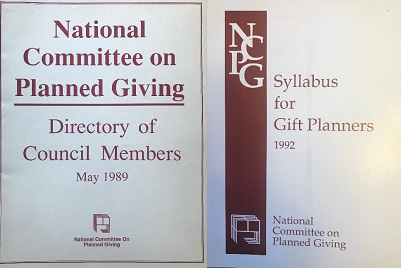 Professional networking was facilitated by publication of the NCPG Directory of Council Members (1989 ff). The NCPG Gift Planner Profile (1992 ff) was based on a survey of 600 practitioners, providing data on compensation, experience, gender, and other career aspects.
 In 1993, Craig Wruck started an open email discussion site (list-serve) entitled Gift-PL at the University of Minnesota. Within a few months the number of subscribers grew to 500.
 Gift Planning History
You must be logged in to post a comment.